
Supply Chain SEO Strategy – How SEO Can Be Your Shield Against Global Crisis in Middle East?
 Muslimseo
4 minutes read
Muslimseo
4 minutes read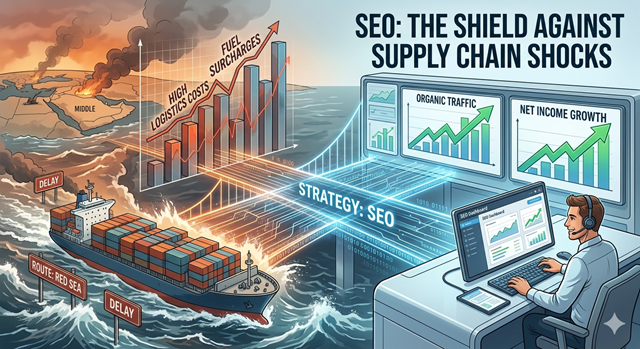
The start of 2026 has been marked by significant geopolitical complexity, most notably the escalating volatility in the Middle East. While this stability crisis is a tragedy first and foremost, its ripple effects are being felt acutely by e-commerce businesses in the West. We are witnessing a collision between fragile global logistics networks and high-cost consumer markets.
Supply Chain SEO Strategy
The immediate result for many Western e-commerce operators is a profound margin squeeze. The crisis has created dangerous detours for container ships that previously utilized the Suez Canal. Long reroutes around the Cape of Good Hope add weeks to delivery times and drastically inflate fuel and insurance premiums, illustrating how global conflicts ripple into local gas prices and operational overhead.
Simultaneously, Western businesses are facing a dangerous dynamic in their marketing departments: Ad Spend Inflation. Platforms like Meta and Google are seeing intense competition for visibility. This means even if a business maintains its revenue through higher prices, its customer acquisition cost (CAC) often spirals, leaving the actual income flat—or shrinking. Dropshipping models and low-margin retailers, unable to absorb these sudden logistical hikes, are struggling to survive this execution-era environment.
The Foundation of Organic Stability in SEO
In this landscape of high logistics costs and volatile paid traffic, Search Engine Optimization (SEO) has evolved from a marketing tactic to a critical financial shield. The most powerful way SEO helps is by creating a stable foundation of low-cost, high-intent traffic, reducing a business’s dangerous reliance on paid acquisition.
When a potential customer discovers your business through organic search, your acquisition cost is significantly lower than if they clicked a paid ad. In 2026, where every logistics dollar counts, protecting that “last mile” profit means reducing your dependence on the digital marketing “tax.” A robust SEO strategy drives consistent volume that doesn’t disappear when the daily ad budget is reached; for those new to the space, following a simple business guide to invest SEO can help stabilize cash flow precisely when logistical volatility hits hard.
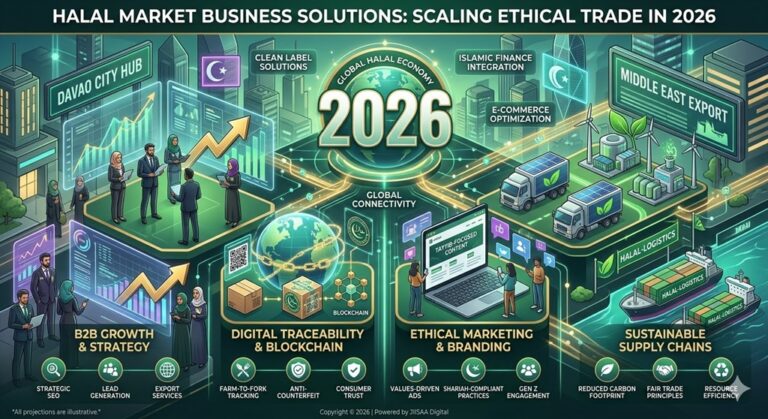
Furthermore, a sophisticated SEO strategy builds resilience by answering consumer questions before they arise. Modern shoppers are value-conscious; they are “trading down” and “subscription fatigued.” Instead of just ranking for product names, a strong SEO approach creates authoritative, educational content that answers searchers’ real questions: “How does this justify its cost?” or “Will I have difficulty with a return?” Providing this transparency builds deep trust, improving conversion rates—a principle central to Halal Market Business Solutions – Scaling Ethical Trade in 2026, where consumer values drive purchasing decisions even in tight economies.
The Technical SEO: Performance and AI
SEO also addresses technical efficiency, which is vital in a challenging economy. The discipline of modern SEO demands an ultra-fast, mobile-optimized experience. Search engines prioritize sites that load efficiently. A faster, easier-to-use site has a direct correlation to lower bounce rates and higher conversion rates. By investing in a technically superior SEO structure, a business effectively “fixes its funnel,” ensuring that all visitors (paid and organic) are more likely to make a purchase, thus reducing wasted marketing spend.
Finally, the landscape has evolved into Generative Engine Optimization (GEO). Search engines are no longer just lists of links; they are AI-driven answer engines. Western consumers are increasingly relying on AI summaries to make buying decisions. A forward-thinking SEO strategy utilizes structured data and deep semantic clarity, positioning a company’s products to be the ones cited and recommended within these AI results. This captures “zero-click” traffic and secures a presence in the new algorithmic ecosystem.
The core challenge for e-commerce in 2026 is execution and structural efficiency. Logistics will remain volatile and paid ads will remain expensive. By building a powerful, permanent digital asset through organic optimization, businesses are not just marketing—they are fortifying their income against the next global storm.
About the Author