
When we talk about digital marketing and search engine optimization (SEO) for Islamic niches, tracking what your readers are looking for is everything. On my personal domain, jiisaaduddin.com, and within regional circles, there has been a noticeable surge in traffic surrounding the topic of Duwaya, the traditional practice of taking multiple wives among Maranao Muslims in the Philippines. At the same time, the presence and visibility of Shia jurisprudence in regional discussions have been steadily growing.
This intersection has led to a very specific, frequently searched question that lands on many of our platforms: Why do Shia Muslims allow more than four wives, while Sunni Muslims limit it strictly to four?
To understand this, we must look directly at the jurisprudence, the distinct scripts of the Quran, and the Hadith traditions. As an author and strategist, my goal here is to provide an objective, independent theological breakdown of where these two major schools of thought derive their rules, so you can understand the structural differences in their legal frameworks.
Project: Universal Muslim (UMMAH)
Focus: Halal
Timeline: July 2026
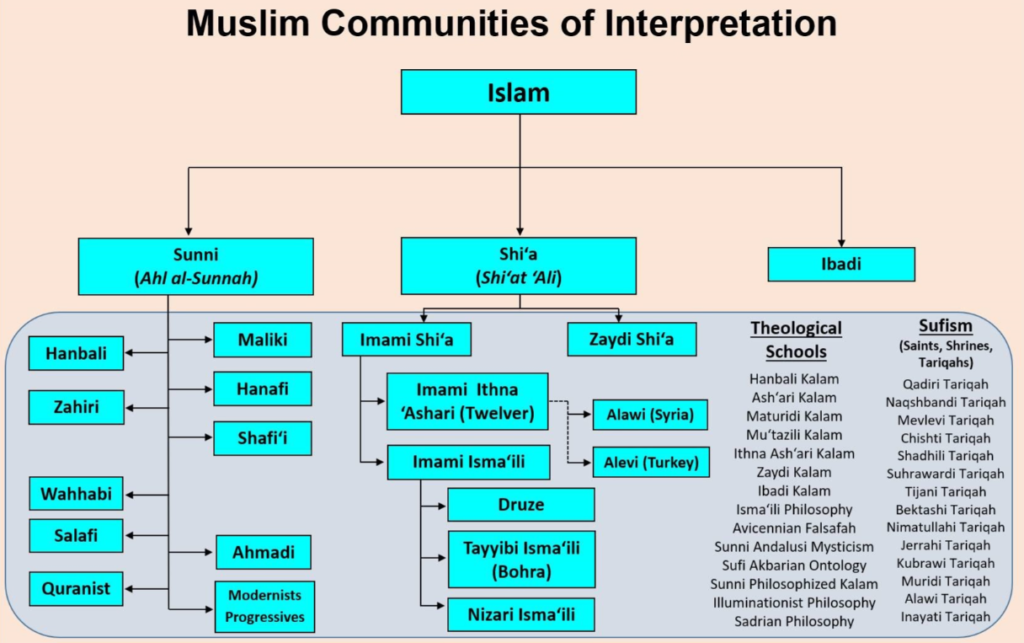
In standard, permanent marriage (Nikah), both Sunnis and Shias follow the same baseline rule based in the Quran: a man is allowed to be married to a maximum of four wives at the same time, provided he can treat them all equally.

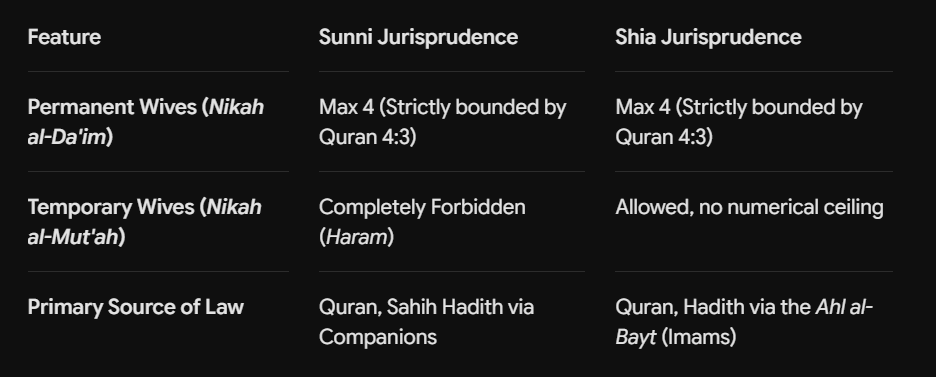
In permanent marriage (Nikah al-Da'im), both Sunni and Shia schools of thought are completely aligned: the absolute limit is four wives at one time.
Mut'ah is a marriage contract that has a pre-arranged expiration date—it could be for a few days, months, or years. When the time is up, the marriage automatically ends without a formal divorce.
Grounding digital growth in kindness, Muslim ethics, and long-term brand respect.
Surah An-Nisa, 4:3
فَانْكِحُوا مَا طَابَ لَكُمْ مِنَ النِّسَاءِ مَثْنَىٰ وَثُلَاثَ وَرُبَاعَ ۖ فَإِنْ خِفْتُمْ أَلَّا تَعْدِلُوا فَوَاحِدَةً
"..fankiḥū mā ṭāba lakum mina-nisā'i mathnā wa-thulātha wa-rubā‘a fa-in khiftum allā ta‘dilū fa-wāḥidatan..."
(...then marry those that please you of [other] women, two or three or four. But if you fear that you will not be just, then [marry only] one...)
Fact Checked: Sunni (Quran.com), Shia (Al-Islam.org)
Surah An-Nisa, 4:3
فَانْكِحُوا مَا طَابَ لَكُمْ مِنَ النِّسَاءِ مَثْنَىٰ وَثُلَاثَ وَرُبَاعَ ۖ فَإِنْ خِفْتُمْ أَلَّا تَعْدِلُوا فَوَاحِدَةً
"..fankiḥū mā ṭāba lakum mina-nisā'i mathnā wa-thulātha wa-rubā‘a fa-in khiftum allā ta‘dilū fa-wāḥidatan..."
(...then marry those that please you of [other] women, two or three or four. But if you fear that you will not be just, then [marry only] one...)
Fact Checked: Sunni (Quran.com), Shia (Al-Islam.org)
Shia Muslims (specifically the Twelver or Imami school) maintain that Nikah al-Mut'ah was never revoked by the Prophet Muhammad. They argue it is a distinct, valid form of marriage established in the Quran that carries no upper numerical limit, unlike permanent marriage.
Sunni Muslims believe that Nikah al-Mut'ah was permitted by the Prophet Muhammad during the early days of Islam (especially during long military campaigns) but was later permanently prohibited by the Prophet himself before his passing. Therefore, Sunnis recognize only Nikah al-Da'im (permanent marriage), rendering any temporary contract strictly forbidden (Haram) and equivalent to fornication (Zina).
Shia scholars point to a specific verse in Surah An-Nisa to prove that this contract is a distinct, divinely sanctioned part of Islam:
Surah An-Nisa, 4:24
فَمَا اسْتَمْتَعْتُمْ بِهِ مِنْهُنَّ فَآتُوهُنَّ أُجُورَهُنَّ فَرِيضَةً
"...fa-mā-stamtat‘tum bihi minhunna fa-ātūhunna ujūrahunna farīḍah..."
(..So for whatever you enjoy [of marriage] from them, give them their due compensation as an obligation...)
The Lexical Meaning
Shia jurisprudence emphasizes that the Arabic root word used here—istamta'tum—comes from the same root as Mut'ah (meaning enjoyment or benefit). They point out that prominent companions of the Prophet, such as Ibn Abbas, historically recited this verse with the phrase "ila ajalin musamma" (for a specified period), explicitly solidifying its link to temporary unions.
Because Mut'ah operates under a different set of legal rules (the woman is not entitled to automatic financial maintenance or automatic inheritance unless stipulated in the contract), Shia scholars rule that the "limit of four" mentioned in Verse 4:3 applies exclusively to permanent wives, leaving the fixed-term option open without a numerical ceiling.
SUNNI
Sunni Muslims rely on major authentic collections (Sahih al-Bukhari and Sahih Muslim) to show that the Prophet Muhammad cleanly outlawed the practice.
Sunni Hadith:
Narrated by Ali bin Abi Talib: "Allah's Messenger (ﷺ) forbade the Mut'ah marriage on the Day of the Battle of Khaybar and also forbade the eating of domestic donkey meat." (Sahih al-Bukhari, 4261; Sahih Muslim, 1407)
For Sunnis, this is an open-and-shut case. The practice was repealed, and following the truth means enforcing a strict limit of four permanent wives.
SHIA
Shia Muslims accept that Ali bin Abi Talib spoke about Mut'ah, but their narration chains state the exact opposite. They argue that the ban did not come from the Prophet, but was rather an administrative ruling introduced later by the second Caliph, Umar ibn al-Khattab, during his reign.
Shia Hadith Reference:
n Sahih Muslim (Book 8, Hadith 3248), Jabir ibn Abdullah reported: "We contracted Mut'ah with a handful of dates and flour during the lifetime of Allah's Messenger (ﷺ) and during the caliphate of Abu Bakr until Umar forbade it in the case of Amr ibn Huraith."
Shia Muslims follow the school of the Ahl al-Bayt (the family of the Prophet) and the rulings of their Imams, who strongly maintained that what the Prophet made lawful cannot be made unlawful by anyone else later on. For them, Mut'ah acts as a social safety valve to prevent severe sins like adultery in times of travel, economic hardship, or societal transition.
For publishers and strategists targeting Islamic markets—whether analyzing the cultural practices of Duwaya in Lanao or addressing the growth of Shia communities across the Philippines—it is vital to present these differences accurately.
Neither side claims to arbitrarily ignore the Quran. Instead, the Sunni school stands on the platform of complete abrogation of temporary contracts, while the Shia school operates on the platform of sustained, dual-track marriage options (permanent and temporary). Understanding these underlying legal mechanisms is the key to writing authoritative, highly objective content that resonates clearly with search intent.
For further academic and legal reading on the distinct mechanics of Islamic jurisprudence, you can cross-reference the verified legal codifications available on the Official Website of Al-Sayyid Ali Al-Husseini Al-Sistani for Shia legal frameworks, and Sunnah.com for secondary analysis of Sunni Hadith compilations.


When we talk about digital marketing and search engine optimization (SEO) for Islamic niches, tracking what your readers are looking for is everything. On my personal domain, jiisaaduddin.com, and within regional circles, there has been a noticeable surge in traffic surrounding the topic of Duwaya—the traditional practice of taking multiple wives among Maranao Muslims in the Philippines. At the same time, the presence and visibility of Shia jurisprudence in regional discussions have been steadily growing.
This intersection has led to a very specific, frequently searched question that lands on many of our platforms: Why do Shia Muslims allow more than four wives, while Sunni Muslims limit it strictly to four?
To understand this, we must look directly at the jurisprudence, the distinct scripts of the Quran, and the Hadith traditions. As an author and strategist, my goal here is to provide an objective, independent theological breakdown of where these two major schools of thought derive their rules, so you can understand the structural differences in their legal frameworks.
Before addressing the differences, we must correct a common misconception. In permanent marriage (Nikah al-Da’im), both Sunni and Shia schools of thought are completely aligned: the absolute limit is four wives at one time.
Neither Sunni nor Shia mainstream jurisprudence allows a man to have five, six, or seven permanent wives simultaneously. The basis for this universal limit is found directly in the Holy Quran:
Arabic:
فَانْكِحُوا مَا طَابَ لَكُمْ مِنَ النِّسَاءِ مَثْنَىٰ وَثُلَاثَ وَرُبَاعَ ۖ فَإِنْ خِفْتُمْ أَلَّا تَعْدِلُوا فَوَاحِدَةً
Transliteration:
…fankiḥū mā ṭāba lakum mina-nisā’i mathnā wa-thulātha wa-rubā‘a fa-in khiftum allā ta‘dilū fa-wāḥidatan…
Translation:
“…then marry those that please you of [other] women, two or three or four. But if you fear that you will not be just, then [marry only] one…” (Surah An-Nisa, 4:3)
This verse serves as the constitutional boundary for regular marriage in Islam. While pre-Islamic Arabia practiced unrestricted polygyny, Islam restricted it to a maximum of four, conditional upon absolute justice (‘Adl) in treatment, maintenance, and time. Both Sunni and Shia scholars agree that if a man takes a fifth permanent wife, that contract is entirely invalid (Batil).
The reason people assume Shia Islam allows “more than four wives” stems from a completely different legal structure known as Nikah al-Mut’ah (temporary or fixed-term marriage).
Shia scholars point to a specific verse in Surah An-Nisa to prove that this contract is a distinct, divinely sanctioned part of Islam:
Arabic:
فَمَا اسْتَمْتَعْتُمْ بِهِ مِنْهُنَّ فَآتُوهُنَّ أُجُورَهُنَّ فَرِيضَةً
Transliteration:
…fa-mā-stamtat‘tum bihi minhunna fa-ātūhunna ujūrahunna farīḍah…
Translation:
“…So for whatever you enjoy [of marriage] from them, give them their due compensation as an obligation…” (Surah An-Nisa, 4:24)
The Lexical Meaning: Shia jurisprudence emphasizes that the Arabic root word used here—istamta’tum—comes from the same root as Mut’ah (meaning enjoyment or benefit). They point out that prominent companions of the Prophet, such as Ibn Abbas, historically recited this verse with the phrase “ila ajalin musamma” (for a specified period), explicitly solidifying its link to temporary unions.
Because Mut’ah operates under a different set of legal rules (the woman is not entitled to automatic financial maintenance or automatic inheritance unless stipulated in the contract), Shia scholars rule that the “limit of four” mentioned in Verse 4:3 applies exclusively to permanent wives, leaving the fixed-term option open without a numerical ceiling.
To understand who considers themselves to be following the absolute “truth” of Islam, one must look at how both sides interpret history through Hadith literature. Both schools believe they are strictly adhering to the authentic Sunnah (tradition) of the Prophet.
Sunni Muslims rely on major authentic collections (Sahih al-Bukhari and Sahih Muslim) to show that the Prophet Muhammad cleanly outlawed the practice.
Hadith:
Narrated by Ali bin Abi Talib: “Allah’s Messenger (ﷺ) forbade the Mut’ah marriage on the Day of the Battle of Khaybar and also forbade the eating of domestic donkey meat.” (Sahih al-Bukhari, 4261; Sahih Muslim, 1407)
For Sunnis, this is an open-and-shut case. The practice was repealed, and following the truth means enforcing a strict limit of four permanent wives.
Shia Muslims accept that Ali bin Abi Talib spoke about Mut’ah, but their narration chains state the exact opposite. They argue that the ban did not come from the Prophet, but was rather an administrative ruling introduced later by the second Caliph, Umar ibn al-Khattab, during his reign.
Shia sources cite historical traditions found even within Sunni texts to support this timeline:
Hadith Reference:
In Sahih Muslim (Book 8, Hadith 3248), Jabir ibn Abdullah reported: “We contracted Mut’ah with a handful of dates and flour during the lifetime of Allah’s Messenger (ﷺ) and during the caliphate of Abu Bakr until Umar forbade it in the case of Amr ibn Huraith.”
Shia Muslims follow the school of the Ahl al-Bayt (the family of the Prophet) and the rulings of their Imams, who strongly maintained that what the Prophet made lawful cannot be made unlawful by anyone else later on. For them, Mut’ah acts as a social safety valve to prevent severe sins like adultery in times of travel, economic hardship, or societal transition.
| Feature | Sunni Jurisprudence | Shia Jurisprudence |
| Permanent Wives (Nikah al-Da’im) | Max 4 (Strictly bounded by Quran 4:3) | Max 4 (Strictly bounded by Quran 4:3) |
| Temporary Wives (Nikah al-Mut’ah) | Completely Forbidden (Haram) | Allowed, no numerical ceiling |
| Primary Source of Law | Quran, Sahih Hadith via Companions | Quran, Hadith via the Ahl al-Bayt (Imams) |
For publishers and strategists targeting Islamic markets—whether analyzing the cultural practices of Duwaya in Lanao or addressing the growth of Shia communities across the Philippines—it is vital to present these differences accurately.
Neither side claims to arbitrarily ignore the Quran. Instead, the Sunni school stands on the platform of complete abrogation of temporary contracts, while the Shia school operates on the platform of sustained, dual-track marriage options (permanent and temporary). Understanding these underlying legal mechanisms is the key to writing authoritative, highly objective content that resonates clearly with search intent.
For further academic and legal reading on the distinct mechanics of Islamic jurisprudence, you can cross-reference the verified legal codifications available on the Official Website of Al-Sayyid Ali Al-Husseini Al-Sistani for Shia legal frameworks, and Sunnah.com for secondary analysis of Sunni Hadith compilations.
Jii Saaduddin is an Digital Strategist specialized in SEO with over 12 years of experience in website and marketing. He helps many businesses scale long-term and short-term across multiple industries.
hello@jiisaaduddin.com
+63 907-SAADUDDIN
Add Listing
Copyright © 2026 Digital Growth Parnter by Jii Saaduddin