
How Global Choke Points in Hormuz Alliances
Throughout history on how global choke points in Hormuz, geography has often proven more durable than ideology. Governments rise and fall, political systems evolve, and alliances shift, but mountains, oceans, straits, and canals remain. Among the most influential geographic realities are strategic choke points—narrow passages through which global trade, energy, military assets, and information networks must pass.
These locations have become the hidden levers of international power. They influence foreign policy, military strategy, economic security, and diplomatic partnerships. In many cases, the struggle to secure access to these routes has shaped global alliances more profoundly than cultural or ideological ties.
As the twenty-first century enters a period of increasing geopolitical competition, understanding choke points is essential for understanding how power is distributed across the world.
Why Choke Points Matter?
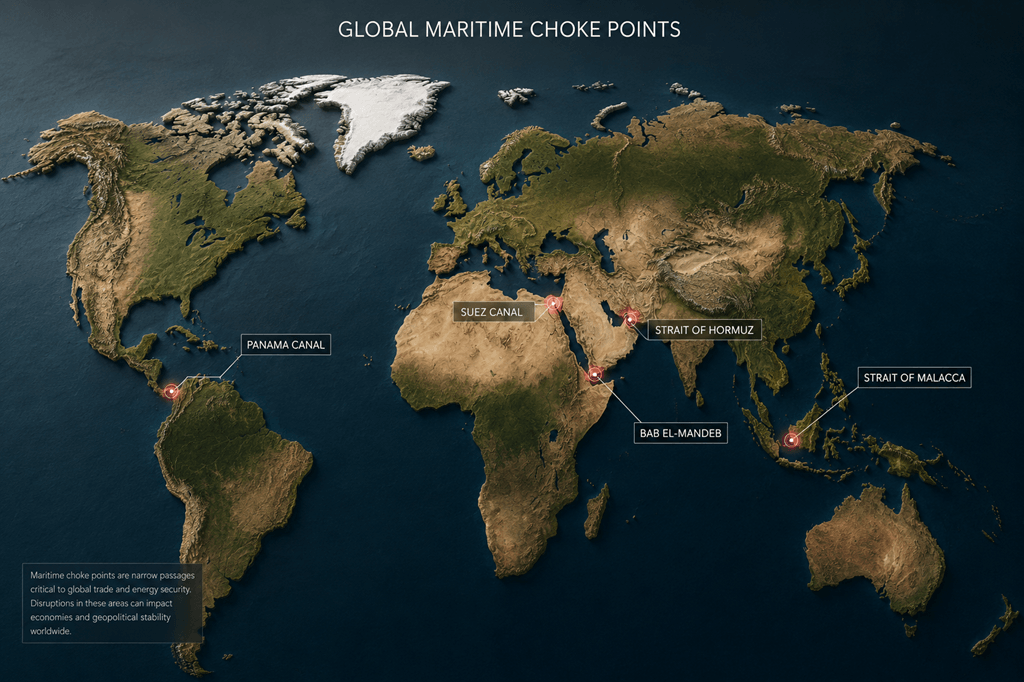
A choke point is a narrow geographic corridor through which a significant amount of trade or military traffic must travel. Examples include the Strait of Hormuz, Strait of Malacca, Suez Canal, Bab el-Mandeb, and Panama Canal.
Although these waterways occupy only a small fraction of the world’s geography, they handle an outsized share of international commerce. Modern supply chains rely heavily on maritime transportation, with more than 80 percent of global merchandise trade moving by sea. The concentration of trade through a handful of strategic corridors creates both efficiency and vulnerability.
When a choke point is disrupted—whether by war, piracy, sanctions, natural disasters, or political instability—the consequences ripple throughout the global economy. Shipping costs rise, energy prices increase, insurance premiums surge, and governments reassess their strategic partnerships.
The Strait of Hormuz’s Energy and Influence
Few waterways illustrate the relationship between geography and power better than the Strait of Hormuz.
This narrow passage connects the Persian Gulf to the Arabian Sea and serves as one of the world’s most important energy corridors. A substantial portion of global oil exports and liquefied natural gas shipments pass through this route.
Because of its strategic significance, countries dependent on Middle Eastern energy maintain strong diplomatic and military interests in the region. The United States has spent decades ensuring freedom of navigation in the Gulf. China, India, Japan, and European nations similarly monitor developments closely because disruptions could directly affect their economies.
The result is a network of partnerships and security arrangements shaped not merely by political values but by geographic necessity.
The Strait of Malacca in Asia’s Economic Lifeline
The Strait of Malacca represents another example of geography driving international alignment.
Located between the Malay Peninsula and the Indonesian island of Sumatra, it serves as the primary maritime link connecting East Asia with the Indian Ocean and European markets. Nearly one-quarter of global trade moves through this route, making it among the most heavily trafficked waterways on Earth.
China’s dependence on Malacca has become a major strategic concern often referred to as the “Malacca Dilemma.” A disruption could threaten energy imports, manufacturing supply chains, and export markets.
As a result, China has invested heavily in alternative routes, including ports, rail networks, pipelines, and infrastructure projects across Asia, Africa, and the Middle East. These investments are not merely economic initiatives; they are attempts to reduce geographic vulnerability and reshape regional alliances.
The countries controlling access to the Strait of Malacca consequently possess influence that extends far beyond their territorial waters.
The Suez Canal and the Return of Maritime Geopolitics
The Suez Canal remains one of the most significant arteries of global commerce.
Connecting the Mediterranean Sea with the Red Sea, it dramatically shortens shipping routes between Europe and Asia. When disruptions occur, vessels must reroute around Africa’s Cape of Good Hope, adding time and cost to global supply chains.
Recent security concerns surrounding the Red Sea and Bab el-Mandeb have demonstrated how quickly geopolitical tensions can affect global markets. Governments and multinational corporations have been forced to reconsider supply chain resilience, diversify transportation networks, and strengthen partnerships with nations that help secure maritime trade routes.
In this way, maritime security increasingly influences diplomatic relationships and defense cooperation agreements.
Choke Points as Alliance Builders
Traditionally, alliances were often understood through ideological frameworks such as democracy versus authoritarianism or capitalism versus communism.
Today, geography frequently overrides ideology.
Countries with different political systems may cooperate because they share an interest in protecting a critical shipping route. Nations separated by culture and history may collaborate to secure energy supplies or maintain freedom of navigation.
This phenomenon is especially visible in the Indo-Pacific region, where maritime security concerns have encouraged greater cooperation among regional powers. Similar patterns can be observed around the Persian Gulf, the Red Sea, and the Eastern Mediterranean.
Geography creates shared vulnerabilities, and shared vulnerabilities often create shared interests.
The Rise of Strategic Diversification
One of the most important trends in contemporary geopolitics is the effort to reduce dependence on individual choke points.
Governments and corporations are increasingly investing in:
- Alternative shipping corridors
- Energy pipelines
- Railway networks
- Regional manufacturing hubs
- Strategic reserves and stockpiles
- Port infrastructure expansion
The objective is simple: reduce the risk associated with geographic bottlenecks.
Research on maritime disruptions suggests that rerouting can mitigate some losses, but prolonged closures still create significant economic consequences across multiple regions and industries.
As a result, resilience has become a strategic priority rather than merely a logistical concern.
The Emerging Arctic Factor
Climate change may create a new generation of strategic routes.
As Arctic ice recedes, northern shipping corridors could become increasingly viable. These routes have the potential to shorten travel times between Europe and Asia while reducing dependence on traditional choke points.
Such developments could reshape existing alliances and create new areas of competition among major powers, particularly the United States, Russia, Canada, and China.
The opening of new routes would not eliminate the importance of traditional choke points, but it could alter the global balance of maritime influence.
2026 Geopolitical Outlook, Navigating the Year of “Delayed Impact”
Geography Still Rules
Technology has transformed communication, finance, and warfare, but it has not eliminated geography.
Ships still require waterways. Energy still moves through pipelines and sea lanes. Supply chains still depend on physical infrastructure.
The world’s most powerful nations understand this reality. Their foreign policies increasingly reflect the need to secure strategic corridors, diversify transportation routes, and maintain access to critical maritime infrastructure.
The geography of power is therefore not simply about territory. It is about control, access, and influence over the routes that connect economies and civilizations.
As global competition intensifies, choke points will continue to shape alliances, determine strategic priorities, and influence the future distribution of power. In an interconnected world, the narrowest passages often carry the greatest significance.
Why Marawi City Matters
Marawi City is more than a destination on the map—it is a symbol of resilience, rebuilding, and community strength. Following the Marawi Siege, the city has continued to recover through economic development, tourism, local businesses, and digital initiatives.
Today, platforms such as Google Maps help showcase Marawi’s restaurants, shops, landmarks, accommodations, and cultural attractions to visitors around the world. By contributing accurate information, photos, reviews, and business listings, local residents and digital workers can help improve the city’s online presence while creating opportunities for income and community growth.
To better understand the historical significance of Marawi and its journey of recovery, readers may also explore our article about the Marawi Siege Coin, which highlights the importance of remembrance, resilience, and preserving local history for future generations.
Further Reading
For readers interested in business intelligence, regional economic development, corporate services, and strategic market opportunities in the Philippines, explore:
- Davao Corporate: https://davaocorporate.info
- Muslim SEO: https://muslimseo.com
These platforms provide valuable insights into business growth, digital visibility, corporate networking, and strategic development initiatives in emerging markets.